
Rolling mills are a core component of metal processing operations, used to reduce thickness, improve material properties, and prepare metal for downstream applications. Whether part of a coil processing line or operating as a stand-alone system, rolling mills play a critical role in production efficiency, material quality, and throughput.
For manufacturers evaluating rolling mills, understanding the differences between mill configurations, reduction capabilities, and integration requirements is essential for making the right investment.
This guide outlines the key types of rolling mills, how they function in production environments, and what to consider when selecting a system for your facility.
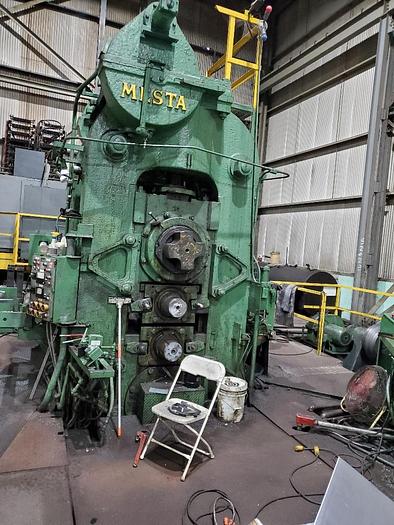
What a Rolling Mill Does in a Production Environment
At its core, a rolling mill reduces material thickness and improves uniformity by passing metal through one or more sets of rolls.
Rolling mills are used to:
- Reduce gauge
- Improve flatness and shape
- Control mechanical properties
- Prepare strip for slitting, forming, or stamping
Rolling can be performed under:
- Hot rolling conditions for large reductions (link to another article on hot/cold rolling)
- Cold rolling conditions for precision thickness and surface finish (link to another article on hot/cold rolling)
In coil processing environments, rolling mills often work alongside:
- Uncoilers and recoilers
- Slitting lines
- CTL lines
- Tension leveling systems
Key Rolling Mill Configurations
Rolling mills are classified based on roll arrangement and application. Understanding these differences is critical when evaluating used equipment.
2-High Rolling Mills
2-high rolling mills are one of the most common and cost-effective configurations.
They are used for:
- Skin passing
- Light reduction
- Flattening operations
- Processing soft materials
Advantages:
- Simpler design
- Lower cost
- Large roll diameter allows strong “bite” on material
Limitations:
- Reduced precision compared to multi-roll mills
- Roll flattening can limit reduction accuracy
2-high mills are frequently used in:
- Pickle lines
- Galvanizing lines
- Surface conditioning applications
3-High Rolling Mills
3-high rolling mills incorporate a work roll between two backup rolls.
They are typically used for:
- Minimal reduction applications
- Specialized materials
- Expanded metal processing
They can also be integrated into slitting or CTL lines as low-cost skin pass solutions.
4-High Rolling Mills
4-high mills are widely used in high-production environments.
Configuration:
- Two smaller work rolls
- Two larger backup rolls
Advantages:
- Greater reduction capability
- Improved thickness control
- Ability to handle higher forces
- Reduced roll deflection
They are commonly used for:
- Steel
- Aluminum
- Copper
- High-volume strip processing
Advanced systems may include:
- Hydraulic screwdowns
- Automatic gauge control
- Roll bending systems
6-High Rolling Mills
6-high mills add intermediate rolls between work rolls and backup rolls.
Benefits:
- Improved control over strip shape
- Reduced edge drop
- Better performance on light gauge materials
These mills are often used in:
- High-speed production environments
- Light gauge steel processing
- Precision rolling applications
Cluster Rolling Mills (10-High, 14-High, 18-High)
Cluster mills are designed for:
- High strength alloys
- Stainless steel
- Precision rolling
Key advantages:
- Extremely tight tolerances
- Ability to process hard materials
- High reduction capability
They are commonly used where precision and surface quality are critical.
Specialized Rolling Mill Types
Beyond standard configurations, specialized mills serve specific applications.
Continuous Rolling Mills
Continuous mills use multiple stands in sequence, with synchronized speeds.
Benefits:
- High production efficiency
- Continuous material flow
- Consistent reduction
Planetary Rolling Mills
Designed for high reduction in a single pass.
Used for:
- Slab to strip conversion
- High-throughput operations
Compacting Rolling Mills
Used to convert powder or particulate material into continuous strip.
Applications include:
- Exotic alloys
- Aerospace materials
- Specialty manufacturing
Embossing Rolling Mills
Embossing mills create patterns or textures in metal without reducing thickness.
Used in:
- Architectural panels
- Automotive components
- Decorative applications
The Role of Tension in Rolling Mill Performance
Tension plays a critical role in rolling mill operation.
Proper tension:
- Reduces required rolling force
- Improves strip tracking
- Enhances thickness control
- Supports higher reductions
In multi-stand or tandem mills, tension is created between stands and maintained by:
- Uncoilers
- Recoilers
- Bridle rolls
Without proper tension control, material may not track properly through the mill, leading to defects and inefficiencies.
Integration With Coil Processing Equipment
Rolling mills rarely operate in isolation. They are typically integrated into full coil processing lines that include:
- Uncoilers for controlled feed
- Recoilers for consistent coil build
- Slitting lines for width reduction
- CTL lines for sheet production
Proper integration ensures:
- Stable material flow
- Consistent product quality
- Efficient production throughput
Key Factors When Evaluating a Rolling Mill
When purchasing a rolling mill, consider:
Reduction Capability
Determine whether the mill can achieve required thickness reductions.
Material Type
Different configurations perform better with specific alloys and strengths.
Roll Configuration
Match mill type (2-high, 4-high, cluster) to your production needs.
Speed Requirements
High-speed mills are critical for large volume production.
Control Systems
Modern controls improve accuracy, repeatability, and efficiency.
Integration Requirements
Ensure compatibility with existing equipment.
Common Challenges in Rolling Operations
Rolling mills must manage:
- Edge elongation
- Center buckle
- Strip tracking issues
- Heat generation
- Coil tension variation
Advanced mills address these challenges with:
- Roll bending systems
- Shape control
- Gauge control
- Cooling systems
Maintenance Considerations for Rolling Mills
Regular maintenance ensures long-term performance.
Key practices include:
- Routine lubrication
- Roll inspection and replacement
- Alignment checks
- Electrical system inspection
- Preventive maintenance scheduling
Proper maintenance reduces downtime and extends equipment lifespan.
When to Consider Upgrading Your Rolling Mill
You may need to upgrade if:
- Production speeds are limited
- Thickness consistency is inconsistent
- Maintenance costs are increasing
- Control systems are outdated
Upgrading to a properly matched used rolling mill can improve both efficiency and product quality.
Frequently Asked Questions About Rolling Mills
What is a rolling mill used for?
Rolling mills reduce thickness and improve material uniformity through controlled deformation.
What is the difference between hot and cold rolling?
Hot rolling occurs above recrystallization temperature, while cold rolling provides tighter tolerances and improved surface finish.
How long do rolling mills last?
With proper maintenance, rolling mills can operate effectively for decades.
Choosing the Right Rolling Mill for Your Operation
Selecting the right rolling mill requires balancing:
- Reduction requirements
- Material type
- Production volume
- Integration with existing equipment
- Budget constraints
Understanding these factors helps ensure the system aligns with both current production needs and long-term growth.
Closing
If you are evaluating new or used rolling mills for sale, selecting the correct configuration and capacity is essential for achieving consistent output, efficient production, and long-term reliability.
Whether you are expanding an existing line or building a new process, the right rolling mill can significantly impact performance and cost efficiency.
Explore available rolling mills or contact our team to discuss the best solution for your operation. Get A Quote from VX Machinery.