
Understanding the difference between hot rolling and cold rolling is essential when evaluating rolling mills and selecting the right process for your operation. While both methods reduce material thickness and improve uniformity, they differ significantly in temperature, performance, and end-use applications.
For manufacturers considering rolling mills, the choice between hot rolling and cold rolling directly impacts equipment selection, production efficiency, and final product quality.
This guide outlines the key differences between these processes and how they relate to rolling mill configurations.
What Is Hot Rolling?
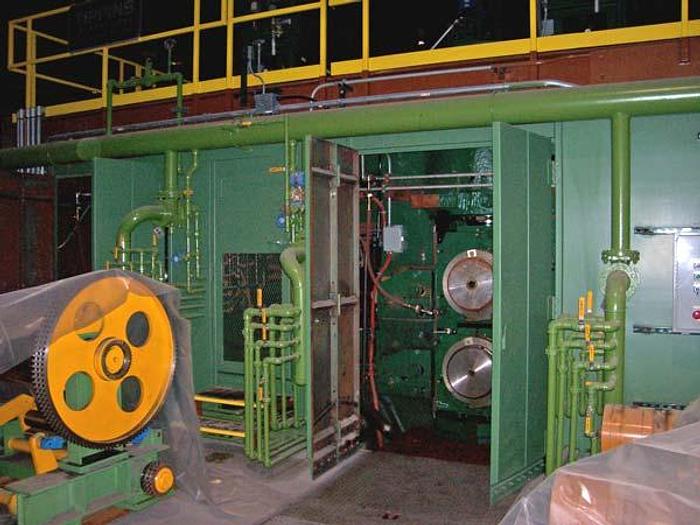
Hot rolling is a metal forming process performed at temperatures above the material’s recrystallization point — typically over 1,700°F for steel.
At this temperature, the material becomes more ductile, allowing it to be shaped and reduced with less force.
Key Characteristics of Hot Rolling:
- Performed at high temperatures
- Allows large reductions in a single pass
- Lower forming force required
- Faster production speeds
- Less precise tolerances
- Rougher surface finish
Hot rolling is commonly used for producing:
- Structural steel
- Plate and sheet
- I-beams and rails
- Large cross-section products
Because of its efficiency, hot rolling is used to process large volumes of material quickly.
What Is Cold Rolling?
Cold rolling is performed below the recrystallization temperature, typically at or near room temperature.
In most cases, cold rolled material begins as hot rolled steel that has been further processed through a rolling mill to achieve tighter tolerances and improved surface quality.
Key Characteristics of Cold Rolling:
- Performed at lower temperatures
- Requires higher rolling force
- Produces tighter dimensional tolerances
- Improves surface finish
- Increases material strength through work hardening
Cold rolling is used to produce:
- Precision strip and sheet
- Coils for slitting and roll forming
- Automotive and appliance components
- Thin gauge materials
Because of its precision, cold rolling is often used in applications where consistency and finish are critical.
Hot Rolling vs Cold Rolling - Key Differences
While both processes use rolling mills, their differences impact equipment requirements and production outcomes.
Temperature
Hot rolling occurs above recrystallization temperature.
Cold rolling occurs below it.
Reduction Capability
Hot rolling allows large reductions in fewer passes.
Cold rolling typically requires multiple passes with smaller reductions.
Surface Finish
Hot rolled material has a rougher surface.
Cold rolled material has a smoother, more refined finish.
Tolerance Control
Hot rolling offers looser tolerances.
Cold rolling delivers precise thickness and dimensional accuracy.
Material Properties
Cold rolling increases strength and hardness through strain hardening.
Hot rolling produces more ductile material.
How These Processes Impact Rolling Mill Selection
When evaluating a rolling mill, understanding the intended process is critical.
Hot Rolling Mill Considerations
- Larger roll diameters
- Higher temperature resistance
- Heavy-duty construction
- Ability to handle large reductions
2-high and certain 4-high rolling mills are often used in hot rolling applications.
Cold Rolling Mill Considerations
- Smaller work rolls for precision
- Higher separating force capability
- Advanced control systems
- Gauge and shape control
4-high, 6-high, and cluster mills are commonly used for cold rolling operations.
Integration With Coil Processing Systems
Both hot and cold rolling processes integrate with coil handling and processing equipment.
In Cold Rolling Applications:
- Uncoilers feed coil into the rolling mill
- Tension control is critical for thickness accuracy
- Recoilers build finished coils for downstream processing
In Hot Rolling Applications:
- Material is often processed in slab or plate form
- Coil handling may occur later in the process
Understanding how rolling integrates with:
- Slitting lines
- Cut To Length lines
- Roll forming equipment
is essential when designing or upgrading a production line.
When to Use Hot Rolling vs Cold Rolling
Choose Hot Rolling When:
- Large reductions are required
- Surface finish is not critical
- High production volume is needed
- Structural applications are the focus
Choose Cold Rolling When:
- Tight tolerances are required
- Surface finish matters
- Material strength needs improvement
- Thin gauge material is being processed
Many operations use both processes depending on product requirements.
Why This Matters When Buying a Used Rolling Mill
For buyers evaluating used rolling mills, understanding the difference between hot and cold rolling helps determine:
- Appropriate mill configuration
- Required roll size and arrangement
- Control system complexity
- Integration with existing equipment
- Expected production output
Choosing the wrong type of mill for your process can result in inefficiencies, increased wear, and inconsistent product quality.
Frequently Asked Questions
What is the main difference between hot rolling and cold rolling?
Hot rolling occurs at high temperatures for large reductions, while cold rolling is performed at lower temperatures for precision and surface quality.
Can the same rolling mill be used for both processes?
Some mills can be adapted, but most are optimized for either hot or cold rolling depending on design and materials.
Why is cold rolling more precise?
Because it is performed at lower temperatures with tighter control over material deformation.
Choosing the Right Rolling Process for Your Operation
Selecting between hot rolling and cold rolling depends on your production goals, material type, and end-use requirements.
If your operation requires:
- High volume and large reductions → hot rolling
- Precision, surface finish, and consistency → cold rolling
Understanding these differences ensures that your rolling mill investment aligns with your production needs.
Closing
If you are evaluating new or used rolling mills, understanding whether your operation requires hot rolling or cold rolling is a critical first step.
For a deeper look at rolling mill configurations, reduction capabilities, and how to choose the right system, see our Complete Guide to Used Rolling Mills. (link to new article)
Or explore available equipment to find the right solution for your operation. Get A Quote from VX Machinery.